AI TOOL / #01481
HyperLLM – Hybrid Retrieval Transformers
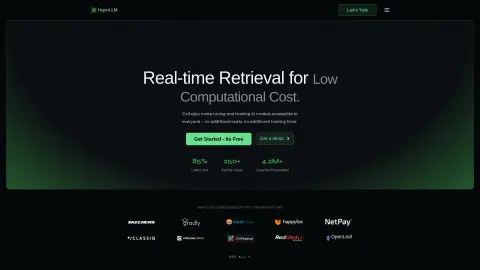
HyperLLM: A compact language model that enables real-time fine-tuning and training at only 85% of the usual costs.
Introduction
HyperLLM: Small Language Models for instant fine-tuning and training at 85% less cost.
What is HyperLLM?
HyperLLM is a new generation of small-scale language models, referred to as “hybrid retrieval transformers.” By leveraging advanced retrieval techniques and world-class serverless embedding technologies, it enables real-time fine-tuning and training, resulting in a 85% reduction in costs. It offers real-time retrieval capabilities that facilitate immediate model tuning, making the optimization and training of AI models accessible to everyone without the need for additional expenses or additional training time. Exthalpy is the variable used to control the hyperparameters of HRT.
How to use HyperLLM?
Start for free and explore various use cases. Integrate Exthalpy into your system by following the provided documentation and API references. Use multiple source URLs to build models in order to create embeddings and answer queries.
The core features of HyperLLM
Model architecture of Hybrid Retrieval Transformer (HRT)
Real-time retrieval enhancement
Serverless vector databases enable complete decentralization.
Zero-latency retrieval architecture (HyperRetrieval)
Using the Exthalpy variable for hyperparameter tuning
Real-time model fine-tuning and training
Related
The new Starkomand
Simultaneous coordination of multiple programming agents on a Mac
New Jockey
TwelveLabs Video Asset Library Agent
New Wingflow
LinkedIn External Communication Automation Tool
New Kubeez
Unified points-based AI video, picture and music creation platform
New Pasta
AI personal fitness coach on iPhone
New MyLens
One-on-one AI explanation and demonstration